Which plan fits your trip
Most visitors to Mostar have one day here, or two. One day is enough to see the old town properly and understand a little of what happened in this city. A second day lets you see the countryside around it, and that is where Herzegovina starts to make sense. If you can sleep here even one night, do. The old town in the evening, after the coaches have gone, is a much calmer place than at noon.
The timings below are realistic rather than ideal. They leave room for coffee, queues and the summer heat. Move things around as you like. The only fixed point is the walking tour, and even its time is something we agree together by email after you book.
| Plan | Best for | What it covers |
|---|---|---|
| One day, sleeping in Mostar | Anyone staying the night before or after | The Old Bridge at a quiet hour, the walking tour, the bazaar, the Crooked Bridge, the Bulevar and the river in the evening |
| A day trip | Visitors coming in from Dubrovnik, Split or Sarajevo | The heart of the old town in the few hours a day trip leaves you |
| Two days | Anyone who can spare a second day | The city on day one; Kravice, Blagaj and Počitelj on day two |
One day in Mostar, hour by hour
This version assumes you slept in Mostar, so you can be at the river early. Day trippers, see the shorter plan in the next section.
| Time | What | Notes |
|---|---|---|
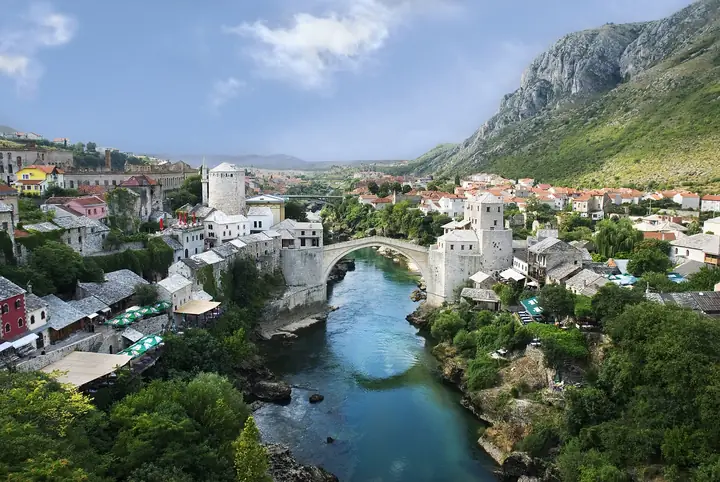
| 7:30 | The Old Bridge before the crowds | Early in the morning the bridge and the lanes around it are nearly empty. Cross it, then walk down to the river stones for the view from below. The Tara Tower, which holds the Museum of the Old Bridge, opens later in the morning, so leave it for another time. |
| 8:30 | Bosnian coffee and burek | Sit down in a café in the old town, order Bosnian coffee and a burek, and take your time over it. My food guide explains how the coffee is served and how to drink it. |
| 10:00, or the time we agree | The free walking tour, about 1.5 hours | We meet at Swimming Club Orka on Mostarskog bataljona street, near the Carinski bridge, about 10 to 15 minutes on foot from the Old Bridge (how to find it). I cover the Old Bridge, the bazaar street and the Ottoman town, and why the bridge matters so much to the people who live here. After that, the rest of the day makes more sense. The tour is free; most guests tip €10–15 per person, about 20–30 KM. |
| 12:00 | Kujundžiluk, the old bazaar | Copper workshops, coffee sets and engraved plates. Some shops also sell wartime items such as engraved shell casings, and some of those are made for the tourist trade rather than being real relics. Think about what you are buying and why. The copper is the older trade here: hand-beaten coffee sets and plates made in the workshops along the street. |
| 13:00 | Lunch: ćevapi | Ten ćevapi in somun with onion and kajmak cost roughly 10–15 KM in the old town, less in a neighbourhood ćevabdžinica. Prices change, so check before you order. Ask me on the tour where I would eat that day. |
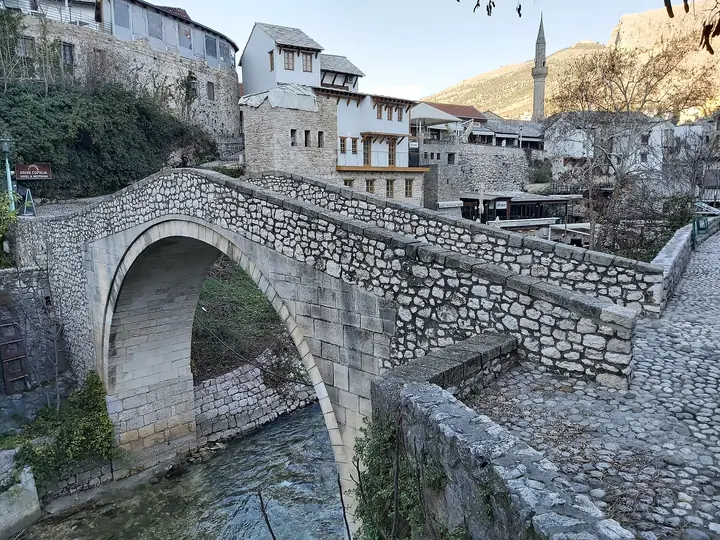
| 14:00 | Kriva Ćuprija, the Crooked Bridge | A minute's walk west of the Old Bridge, over the little Radobolja stream. More on it below. |
| 14:30 | Koski Mehmed Pasha Mosque (optional) | The courtyard and the minaret give you a different angle on the Old Bridge. There is a ticket, about 10–15 KM with the minaret at last report; bring cash in KM and check the price on site. Shoulders and knees covered. My culture guide has the etiquette. |
| 15:30 | The Bulevar, the former front line | From 1993 the front line ran along the Bulevar, west of the river. Many facades still carry the marks, and a few ruined buildings still stand. People live and work here, so look quietly and ask before you photograph anyone. |
| 16:30 | A break | In July and August the afternoon is very hot. Rest in the shade or at your guesthouse for an hour. |
| The hour before sunset | The river in evening light | Stand on the bridge or go back down to the riverbanks as the light turns warm on the stone. Around the end of June the sun sets at about 20:30, by late August at about 19:45, and in winter in the late afternoon. My photography guide has the viewpoints. |
| Evening | Dinner by the river | Eat somewhere with a view of the Neretva, then walk back through the old town once it has gone quiet. |
The Crooked Bridge deserves its few minutes. Traditionally dated to 1558, although the exact date is not known, it is often called a miniature or forerunner of the Old Bridge, which was finished in 1566. Floods swept it away in December 2000, and it was rebuilt with UNESCO help soon after. It sits among restaurants and is rarely empty, but it is smaller and quieter than the main bridge.
The Koski Mehmed Pasha Mosque was badly damaged in the war and restored between 1996 and 2001. What happened along the Bulevar is explained in my war history guide. Every community in Mostar lost people in those years, and the buildings you pass are part of ordinary streets, not a museum.
If you only have a day trip
From Dubrovnik the drive is about two and a half hours each way, plus the border. Croatia now runs the EU Entry/Exit System, so non-EU travellers give fingerprints and a photo at their first crossing, and in summer the queues can be long. Sarajevo is about two hours away by road. Split is further, so allow three hours or more each way. How many hours you actually get in Mostar depends on your bus or driver and on the border, so the order of the day matters more than usual.
| Time | What | Notes |
|---|---|---|
| On arrival, around 11:00 | The walking tour | Tell me your arrival time when you book, and we agree a tour time that fits. Doing the tour first gives the rest of your few hours a shape. |
| After the tour | Lunch | Ćevapi or a burek near the old town. Allow 45 minutes. |
| Afternoon | Bazaar, Crooked Bridge, river stones | All within a few minutes of each other. Walk down to the river for the view of the Old Bridge from below. |
| The last hour | Bulevar or the mosque courtyard | Choose one, then head back to your bus or car with time to spare. |
Day two: Herzegovina by private car
On the second day I drive you out of the city. The Private Herzegovina Car Tour takes up to 6 people in an air-conditioned car, and the price is on request. The day covers three places: Kravice, Blagaj and Počitelj. If you want a long swim at Kravice, we simply slow down.
| Time | Stop | Notes |
|---|---|---|
| 8:30 | Pickup in Mostar | Tell me where you are staying when you enquire. |
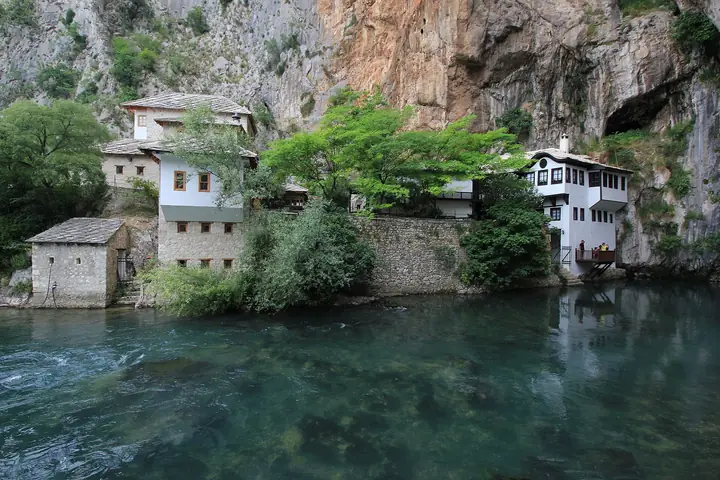
| 8:50 to 10:00 | Blagaj | The dervish house at the Buna spring, before the coaches from the coast arrive. |
| 10:30 to 11:30 | Počitelj | A walk up through the stone village to the fortress tower. |
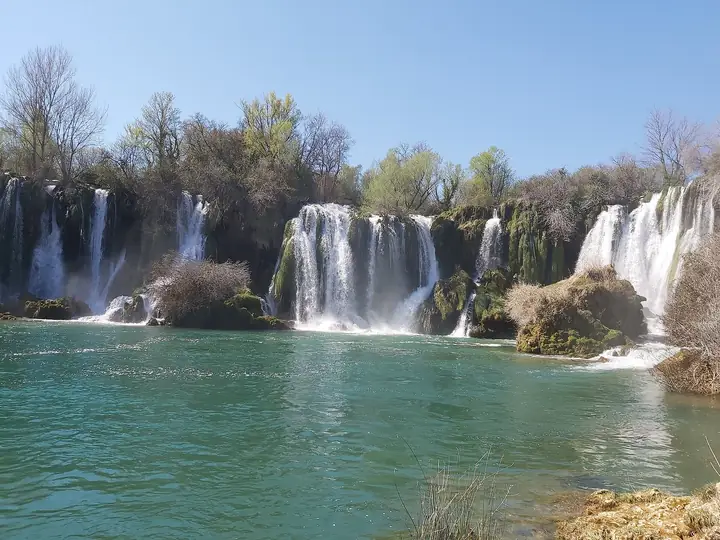
| 12:15 to 14:45 | Kravice waterfalls | A swim in season and lunch at the park. |
| About 15:30 | Back in Mostar | Time to rest before dinner in the old town. |
In July and August I usually turn the day around and start at Kravice at about 9:00, because the falls are busiest between 11:00 and 15:00.
Blagaj
About a quarter of an hour's drive from Mostar. The Buna river comes out of a cave at the foot of a sheer cliff, and beside it stands a whitewashed dervish house (tekija) from the early Ottoman period, with wooden bay windows over the water. It is a living Sufi site, not a museum. The spring is one of Europe's strongest karst springs, with an average flow of roughly 24–30 m³/s (over 100 m³/s in floods), fed from a catchment of about 1,100 km² that includes the Nevesinje plateau.
Going inside costs about 10 KM at last report. Shoulders and knees should be covered, women may be asked to cover their hair, wraps are handed out at the door, and shoes come off inside. The riverbank outside is free.
Počitelj
About half an hour south of Mostar, right on the main road. A medieval fortress town, probably founded around 1383, that flourished under Ottoman rule from 1471; the Hadži Alija mosque dates from 1562–63. Stone houses step up the hill to the tower at the top, and the climb gives you the whole Neretva valley.
During the 1992–95 war, and especially the 1993 Croat–Bosniak conflict, Bosnian Croat (HVO) forces badly damaged Počitelj's 16th-century Ottoman heritage, including the Hadži Alija mosque, and much of the population was expelled. Much of the village has since been restored. The steps are steep and polished, so wear proper shoes. In summer it is a standard stop on the group day tours, and the stone gets very hot after midday; it is quietest early or late.
Kravice waterfalls
About 45 to 50 minutes from Mostar by car. The Trebižat river drops about 28 metres over a curved wall of tufa roughly 120 metres wide into a green pool. The 2026 adult ticket is 20 KM all year, children under 7 go free, and the ticket also covers the Koćuša waterfall and the Humac monastery museum in Ljubuški. Car parking is 3 KM for each hour started. Prices change, so check before you go.
Swimming is allowed at your own risk. The water is cold and deep, there may be no lifeguard, and the park warns about falling tufa. The best months for a swim are June to September. In spring the falls carry the most water. There are cafés and restaurants inside the park, and on this route that is where we stop for lunch.
My day trips guide covers these and other places within reach of Mostar in more detail.
A slower second day in the city
If you would rather not spend the second day in a car, stay in Mostar and take it slowly. Visit the Tara Tower museum at opening time, when the view from it is quietest; the hours vary, so check them locally. Then book a second walk with me: the war history tour covers the two sieges, the front line on the Bulevar and the fall of the bridge, and the cultural experience covers Bosnian coffee, the copper street, and mosques and churches a few hundred metres apart. Leave the evening free for the river.
Getting the season right
- Summer (June to August). Long days and real heat. Do the walking and the climbs in the morning, rest after lunch, and go out again in the evening. At Kravice, go early.
- Spring and autumn. The easiest months for this plan. The days are shorter, so the sunset stop moves earlier in the afternoon.
- Winter. Quiet streets and short days. Kravice closes at 17:00 from November to February and swimming is out of season, but the walk to the falls is still worth it.
Booking both days
For the city day, book the walking tour and tell me when you arrive and when you leave. I reply by email and we agree a time. For the second day, send an enquiry about the private car tour with the number of people, your dates and anything you particularly want to see, and I come back with a route and a price. If you have questions first, the FAQ may already answer them.