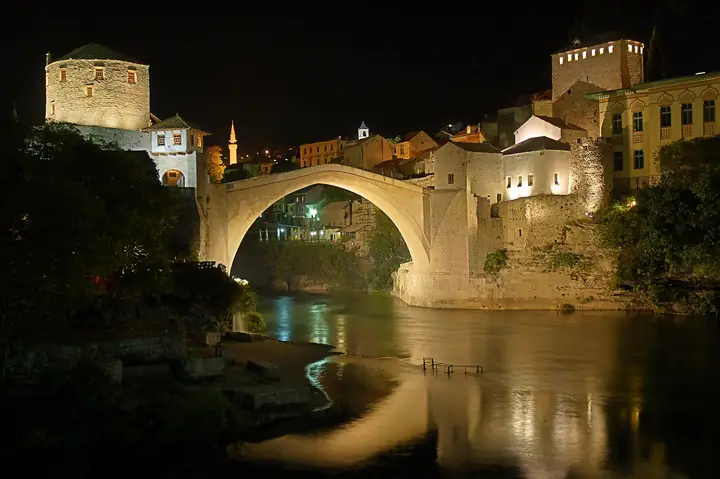
When the light is good
Mostar is stone, water and steep hills, so the hour you choose changes the picture more than the lens does. The limestone of the old town goes warm and golden in low sun and flat and grey at noon. The crowds follow the opposite pattern: almost nobody is on the bridge at sunrise, and by late morning it is full.
- Morning golden hourFrom sunrise for about an hour. In June and July that is roughly 5:15 to 6:30 AM. In spring and autumn it comes later, so check the sunrise time for your dates.
- MiddayFrom about 10 AM to 3 PM in summer the light is hard and straight down, and the bridge is busy. Use these hours for interiors, shade and details.
- Evening golden hourThe hour before sunset. In June and July that is around 7:30 to 8:30 PM. From August the sun sets earlier, around 7:45 PM by late August, so plan your evening shots earlier too.
- After darkThe Old Bridge is lit at night, and the river below it goes black. This is the time for a tripod.
One thing the tables do not tell you: the old town sits in a valley, and the hills can keep direct sun off the river for a while after official sunrise. Treat all these times as approximate and give yourself a margin.
The Old Bridge from the river banks
If you only get up early once, do it for this. At first light you can stand on the east bank a little downstream of Stari Most, get low, and take the bridge and its reflection in one wide frame. The reflection only works when the Neretva is calm, which usually means early morning, before anyone is on the rocks or in the water.
When the river is low, usually in summer, you can climb down to the rocks below the bridge and look straight up at the arch. It is a view most people never take, and it is the best place to stand when the divers jump. The water is cold even in August, and the stones are slippery, so wear shoes with grip and keep your camera on a strap.
Tara Tower and the view from above
Tara Tower, on the east bank right by the bridge, houses the Museum of the Old Bridge. From its height you get the classic angle: the bridge from slightly above, the river below and the Halebija Tower on the far side. There is an entry ticket.
The tower keeps museum hours, so it is no use at sunrise. Published hours differ between sources, roughly from 9 or 10 AM until 6 or 8 PM, and it may close on some days. Go right at opening for the quietest view and check the current hours locally. For a sunrise photo, use the riverbanks instead.
For the wide picture that puts everything in context, go up the hillside above the east bank of the old town. Several cafes and restaurants there have terraces, and at sunset you see the stone roofs, the minarets, the bridge and the gorge of the Neretva together. Buy a coffee and ask before you set up a tripod.
Kujundžiluk before the shops open
The old bazaar street, Kujundžiluk, is two different places. During the day it is packed with shoppers and stalls. Before about 8 AM the shutters are down, the cobbles are empty and the low sun cuts long shadows down the narrow street. Copper plates and coffee sets in the windows catch the light. If you like street photography, this is your hour.
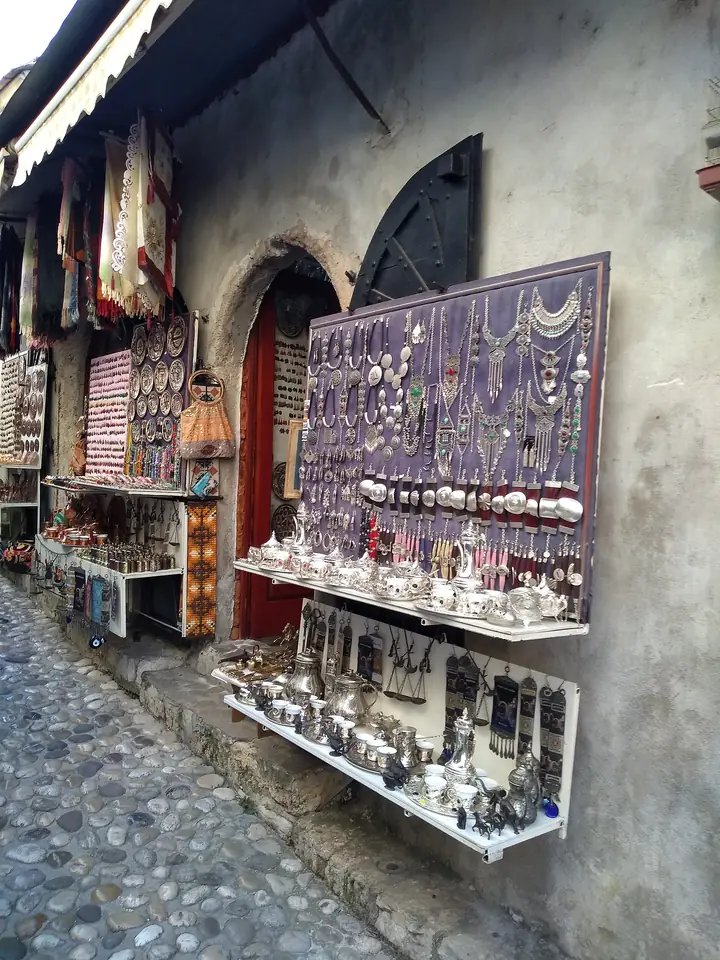
Later in the day, the shops themselves make good pictures, but they are someone's work and livelihood. Ask the owner before you photograph a craftsman at work or a display up close. A purchase, even a small one, is a polite way to say thank you.
The Crooked Bridge and the old town details
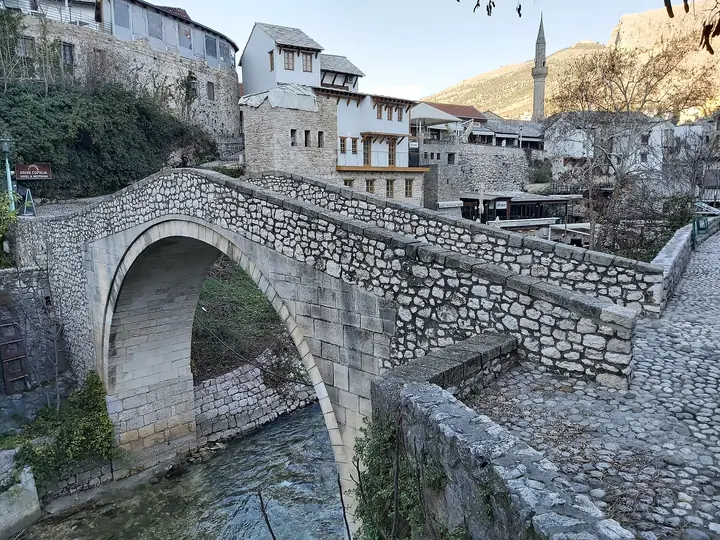
Kriva Ćuprija, the Crooked Bridge, is traditionally dated to around 1558, before the Old Bridge was finished, and is often called its trial run. UNESCO notes that its exact date and builder are not known. Floods washed it away in December 2000 and it was rebuilt in 2001. It spans the small Radobolja stream on the west bank, a few minutes on foot from Stari Most.
Because it is small, you can see the whole arch at close range, with the stone walls and trees around it. That makes it better than the big bridge for architectural detail. It is rarely crowded, and soft morning or evening light suits it best.
The Muslibegović House on the east bank is an Ottoman-era family house that is now partly a museum and partly a small hotel. Its courtyard, with deep shadows and clean geometry, is at its best in late morning. Ask the staff before you photograph, and respect the guests who are staying there.
From some points in the old town you can fit a minaret and a church bell tower into one frame. It takes some walking to find a spot where both stand against clear sky, usually from higher ground or a terrace. I show people a few of these positions on my tours.
The divers and the bridge at night
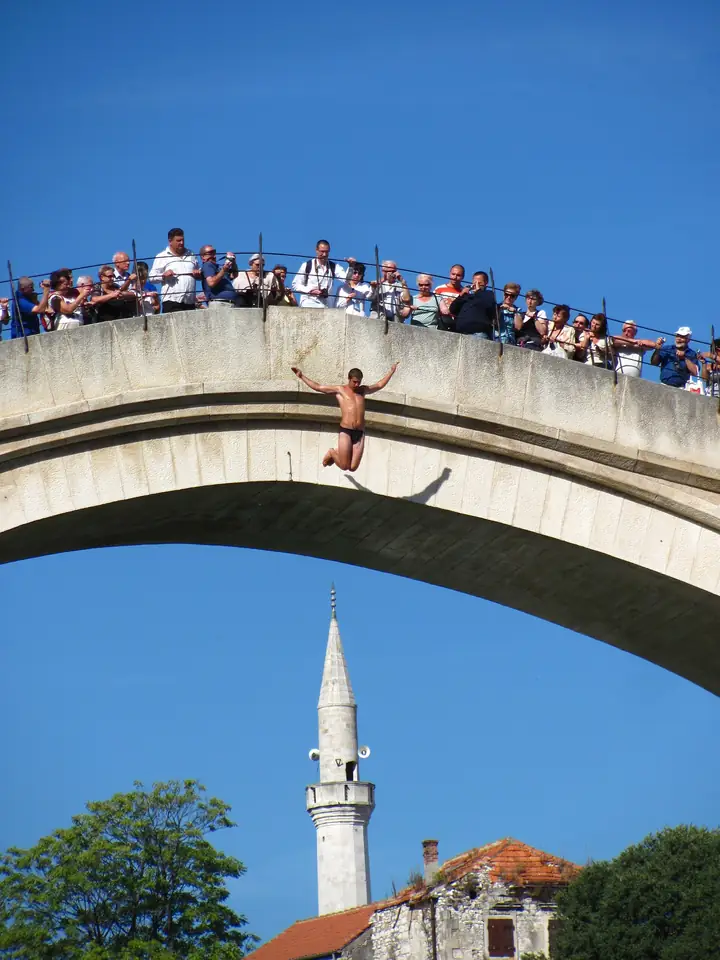
In summer, divers from the local club jump from the top of the Old Bridge, a centuries-old tradition. A diver usually collects money from the people watching before a jump, so there can be a wait. The big event is the annual diving competition in late July, when the banks fill up early.
For the shot, stand on the banks below the bridge and look up. The bridge is about 20 to 24 metres above the water, depending on the river level, so the fall lasts only about two seconds. Set your camera to continuous shooting and a fast shutter speed, and start shooting the moment the diver leaves the parapet.
After dark the lit stone stands out against the water and the sky. Exposures of 5 to 15 seconds from the bank give you the warm bridge and a soft, smooth river. Bring a small tripod, or rest the camera on a wall. Late evening, once the restaurants empty, is quieter than you might expect.
Photographing people, mosques and the war
Ask before you photograph people, especially in the bazaar, near mosques and in residential streets. Most people in Mostar are happy to say yes if you ask with a smile. If you have not asked, do not take the picture.
Inside mosques that are open to visitors, photography is generally allowed, but never during prayer. Check with the person at the entrance, dress modestly and keep your voice down.
The war is still visible in Mostar. Along the Bulevar, the front line of 1993 and 1994, some buildings still carry bullet and shell marks, and a few stand in ruins next to repaired ones. People live in many of these buildings, and every community in this city lost people in the war. Photograph the facades and the contrast between restored and damaged walls if you want to record it, but leave residents out of the frame unless they agree. Please do not pose, smile for selfies or climb into ruins: they are unstable, and they are part of somebody's loss.
Drones and what to bring
Drones must be registered with the Directorate of Civil Aviation of Bosnia and Herzegovina (BHDCA) and are subject to height and area limits. The rules change, so check the current BHDCA rules before you fly. Over the old town in summer there are also a lot of people below you, so think twice even where it is allowed.
- A wide lens for the bridge from the banks and the view from the hills.
- A small tripod for night shots and long exposures of the river.
- A polarising filter to cut glare on the water and bring out the green of the Neretva.
- Shoes with grip for polished cobbles and wet river stones.
If you have time beyond the city, Blagaj and Počitelj are both worth taking the camera to. See my day trips from Mostar, and use the itinerary to fit the best light into your days here.