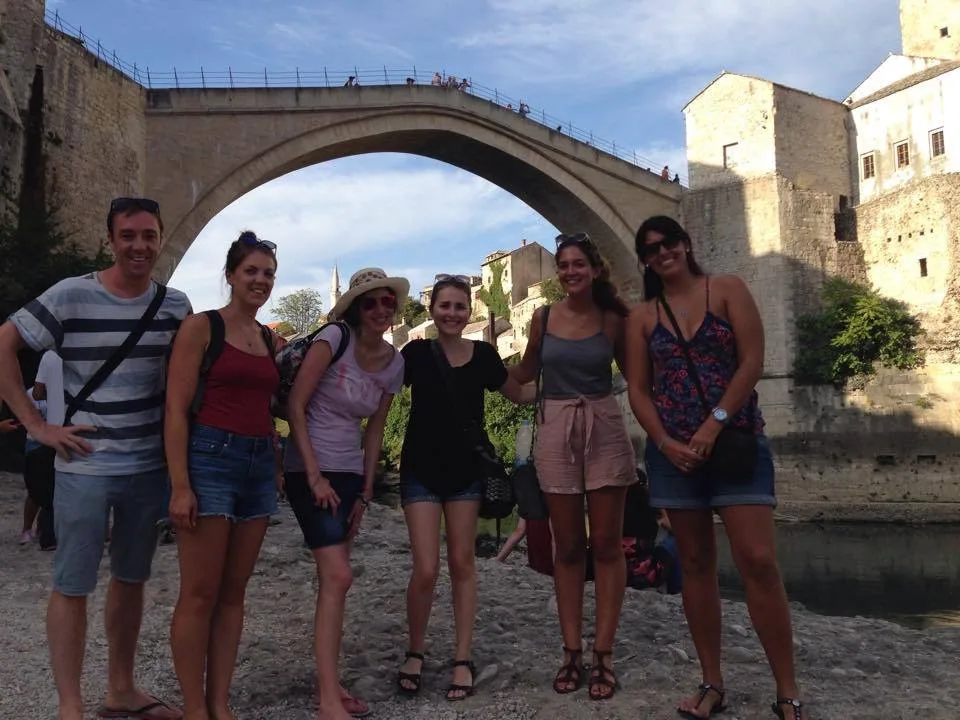
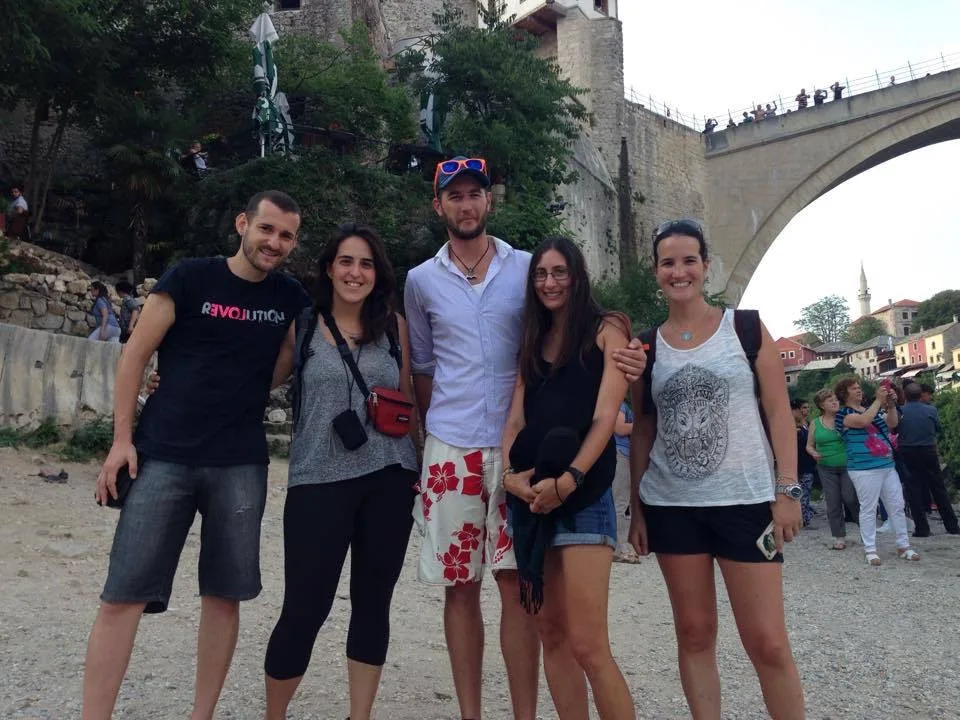
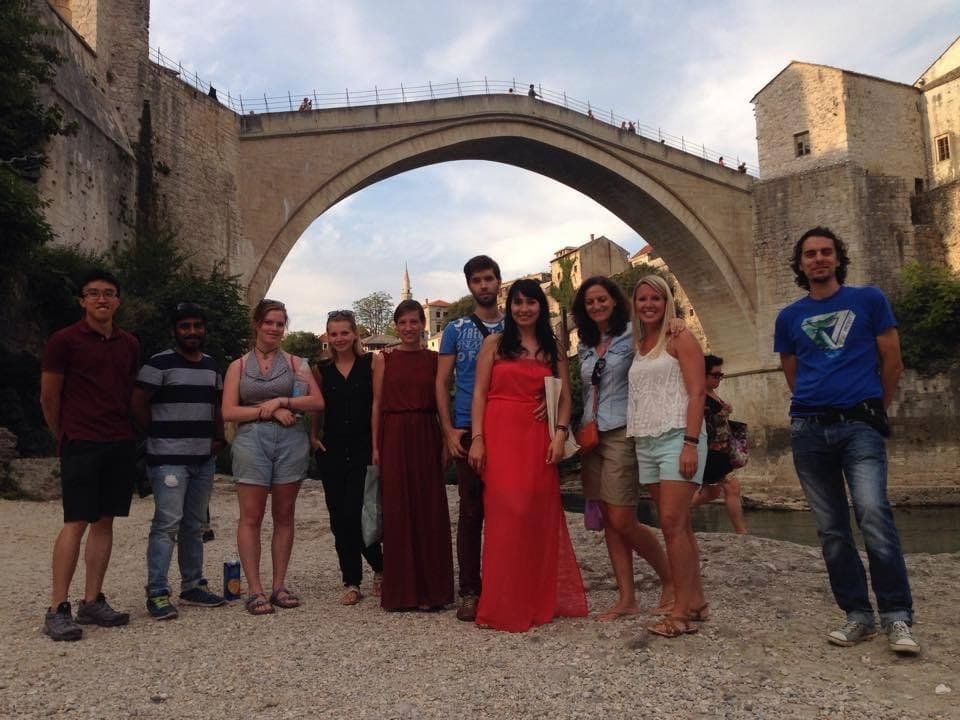
To understand Mostar, you have to understand that almost nothing about it is accidental. The city's location — on a narrow gorge carved by the Neretva River through limestone mountains — made it a crossing point. And crossing points, throughout history, become contested. They become places where empires meet, where cultures collide, and where bridges are built that mean more than just stone over water.
Before the Ottomans: A River Crossing
The land that is now Mostar was inhabited long before any empire claimed it. The limestone plateau of Herzegovina — karstic terrain, porous, dramatic — was home to Illyrian, then Slavic settlements. The Neretva River provided fresh water and a natural trade corridor connecting the Adriatic coast to the Balkan interior.
Medieval Bosnia, a kingdom of complex Christian identity (the Bosnian Church — neither Catholic nor Orthodox in the conventional sense), controlled the region until the mid-15th century. There was a wooden bridge at the Neretva crossing. Timber, functional, forgettable. It needed men to protect it. Those men were called mostari.
Etymology of Mostar
The name Mostar comes from mostari — bridge keepers. Not from the bridge itself, but from the people who protected it. The city is named after its guardians, not its landmark. This distinction matters.
1468: The Ottoman Conquest
In 1468, the Ottoman Empire extended its reach into what is now Bosnia and Herzegovina, absorbing the weakened medieval Bosnian kingdom. The Ottomans were administrators as much as conquerors. They reorganised existing settlements, introduced new legal and economic structures, and — crucially — invested in infrastructure.
The crossing at Mostar became strategically important. The Ottomans built a small fortress on the west bank and reinforced the settlement. The wooden bridge was expanded and maintained. Trade grew. So did the town.
1557: A Bridge That Changed Everything
In 1557, the Ottoman Sultan Suleiman the Magnificent commissioned a stone bridge across the Neretva at Mostar. The architect assigned was Mimar Hayruddin — a student of the great Ottoman court architect Sinan — and he was given a task that may have seemed impossible: a single stone arch spanning 29 metres across a rushing mountain river, rising to 21 metres above the water.
Hayruddin used tenelija, a local limestone quarried from the mountains above Mostar. Tenelija has an unusual property: it gets harder with time, not softer. The longer it's exposed to air, the stronger it becomes. It was the right stone for the right bridge in the right place.
The bridge took nine years to build. When it was completed, it was the widest human-made arch in the world. It remained so for some time.
"He who built it knows how hard it was. He who looks at it knows how beautiful it is."
— Contemporary Ottoman inscription about the bridge
The bridge transformed Mostar from a defended river crossing into a genuine city. Trade, craft workshops, mosques, caravanserais — the entire apparatus of Ottoman urban life took root on both banks. The east bank (right bank when facing north) became the centre of Muslim Ottoman life. The Kujundžiluk — the Coppersmith's Bazaar — developed along the approaches to the bridge. It remains there today.
The Bridge's Lesser-Known Sibling
Kriva Ćuprija — the Crooked Bridge — was built in 1558, one year after Stari Most, as a test of the arch design. It's smaller, crossing a narrow tributary. It survived the Bosnian War intact. Almost no tourists visit it. Our tour takes you there.
The 400-Year Life of the Bridge (1557–1957)
For 427 years, Stari Most stood. Through plague. Through floods. Through the decline of the Ottoman Empire and the arrival of the Austro-Hungarians. Through two World Wars. Through the creation and dissolution of Yugoslavia. The bridge had become so inseparable from Mostar that the two were, in local consciousness, the same thing.
The Austro-Hungarian period (1878–1918) brought railway lines, Viennese architecture, coffee houses, and newspapers to the Balkans. Mostar received a train station, schools, banks, and civic buildings in the Habsburg style — which you can still see in the western part of the city. Two cultures coexisted here, building on, rather than erasing, what came before.
The Yugoslav period (1918–1991, with various political reorganisations) brought further complexity. After World War II, Josip Broz Tito's Socialist Federal Republic of Yugoslavia promoted "Brotherhood and Unity" as its core ideology. Mixed marriages were common. Mostar was ethnically mixed at the street level, the apartment building level, the family level. The 1984 Sarajevo Winter Olympics — broadcast to the world — presented a Yugoslavia that was modern, diverse, and cosmopolitan. Mostar, 130 kilometres south of Sarajevo, shared in that identity.
The divers of Mostar — young men who jumped from the top of Stari Most into the icy Neretva — had been performing this ritual since the 17th century. By the Yugoslav period, it had become an organised club with formal initiation rites. To become a full member of the Mostarski skakači (Mostar Divers), you had to complete the dive — 21 metres, water at around 10°C — and survive.
November 9, 1993: The Bridge Falls
By 1991, Yugoslavia was breaking apart. Slovenia and Croatia declared independence. In 1992, Bosnia and Herzegovina held a referendum on independence. Bosnian Serbs boycotted it; Bosniaks and Croats voted overwhelmingly to separate from Yugoslavia.
What followed in Mostar was uniquely complex. First, the city was besieged by Serbian (JNA and VRS) forces in 1992. Bosniaks and Croats fought together against that siege. Mostar was heavily shelled. Then, in 1993, the alliance collapsed. Croatian forces (HVO) turned on Bosniak forces (ARBiH) in a second conflict that split the city in half along the Bulevar (the main boulevard), which became the frontline.
East Mostar — the old town, the Bosniak side — was besieged by Croatian forces. The population had no food, no water, no medicine, no escape. Mosques and minarets were systematically destroyed — not as collateral damage, but as deliberate acts of cultural erasure.
On November 9, 1993, Croatian artillery positioned on the surrounding hills fired 60 rounds directly at Stari Most. The bridge — 427 years old, having survived plagues, floods, two world wars, and the first Bosnian siege — fell into the Neretva River.
International journalists reported it. International courts later classified the bridge's destruction as a war crime under international humanitarian law. The International Criminal Tribunal for the former Yugoslavia found specific individuals responsible.
An Important Historical Detail
Most Western tourists arrive knowing only that "Bosnia had a war." In fact, Mostar experienced two separate conflicts: a Serbian siege (1992) and then a Croatian-Bosniak war (1993–1994). The bridge was destroyed in the second conflict. This distinction matters — both factually and in terms of understanding the city's current political reality.
The Stones From the River
After the Washington Agreement of February 1994 ended the Croatian-Bosniak conflict, and after the Dayton Agreement of 1995 formally ended the Bosnian War, international attention turned to reconstruction. In Mostar, the most visible symbol was the bridge.
The reconstruction project, led by Turkish experts with international funding and UNESCO oversight, faced an unusual problem: modern stone-cutting techniques could not reproduce the quality of the original tenelija stonework. The 16th-century method — hand tools, specific quarrying techniques, understanding of the stone's grain — had to be researched, recovered, and taught to a new generation of craftsmen.
The original stones from the bridge were recovered from the Neretva riverbed and carefully documented. Some were reused; others were incorporated into the bridge's base. New tenelija was quarried from the same mountains Hayruddin had used in 1557.
The reconstruction took nine years. The same amount of time as the original construction, four and a half centuries earlier.
July 23, 2004: The Bridge Opens
The reopening ceremony of Stari Most was attended by thousands of people — from Mostar, from Bosnia, from across Europe and the world. There were tears. There were divers who jumped from the newly rebuilt bridge into the Neretva, continuing the 400-year tradition that had been interrupted for a decade.
In 2005, Stari Most and the Old City of Mostar were inscribed as a UNESCO World Heritage Site — recognising not just the architectural achievement of the bridge, but the significance of its reconstruction as an act of cultural recovery.
Mostar Today: Still Divided, Still Beautiful
The bridge is rebuilt. The old town has been restored. The tourists have arrived — in the summer months, the Kujundžiluk can feel overwhelmed. But beneath the surface, Mostar remains a city that hasn't finished processing what happened to it.
The Dayton Agreement of 1995 divided Bosnia and Herzegovina into two "entities" — the Federation of Bosnia and Herzegovina (Bosniak and Croat) and Republika Srpska (predominantly Serb). Within the Federation, Mostar sits in a particularly complicated position. The city technically has one government but functions with two separate administrations, two sets of political maps, and two school curricula taught in the same buildings on different schedules.
At street level, this is less dramatic than it sounds. People shop together, drink coffee together, celebrate together. Mostar's famous gostoprimstvo — hospitality — crosses all ethnic lines. But the political division is real, unresolved, and not something your tourist brochure will mention.
Walking across Stari Most today, you are walking across a bridge that carries the weight of all of this. The stones you step on are the same stones Hayruddin placed in the 16th century, reconstructed using the same techniques four centuries later, after being deliberately destroyed. That is a story unlike almost anything else in Europe.
Our walking tours will take you across that bridge. And we'll tell you everything else that it means.
Walk This History In Person
The bridge is beautiful from photos. From the bridge itself, standing on 16th-century stone, looking at a city that rebuilt itself — it's something else entirely.